When comparing close-tolerance benchtop spectrophotometers in the market, the meaningful differences are rarely about a single headline spec. They show up in the day-to-day reality of measurement.
How confidently can you share digital standards across sites and suppliers, how quickly can you keep production moving when something changes. In fact, as you are working with close tolerances, across multiple sites, and with color data flowing through a supply chain, the details behind measurement confidence, repeatability, and operator-proof workflows quickly become the differentiator.
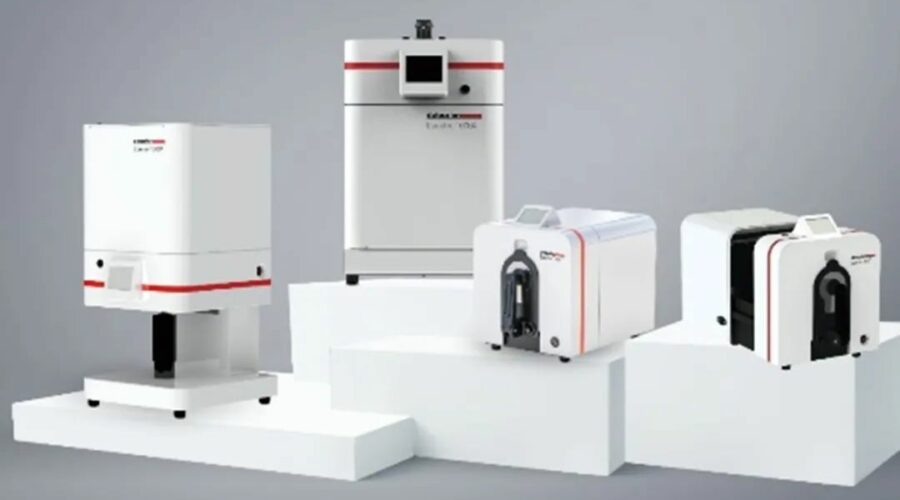
The Datacolor Spectro 1000 Family is built for that reality, delivering Datacolor’s highest-precision benchtop performance with industry-leading inter-instrument agreement for uniform assessment across locations, fast measurement speed, and added assurance through sample temperature measurement. With four configurations to match real-world sample types, a positioning camera and Display screen to reduce placement errors, seamless backward compatibility across Datacolor benchtop fleets, and an included 5-year warranty, it’s designed to keep color decisions consistent, defensible, and efficient.
Here is a practical 6 point guide comparing Spectro 1000 to other benchtop spectrophotometers out there. Just to assure you that it is your best choice in the market.
1. Sample temperature measurement
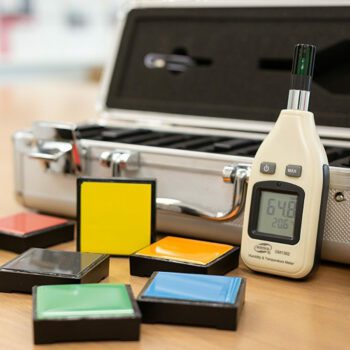
Datacolor’s integrated sample temperature sensor measures the actual surface of the sample—crucial in heat-sensitive workflows like plastic molding or textile dyeing. Integrated sample temperature measurement at the moment and location of the reading, is critical when the sample’s color shifts with heat, cooling time, or process conditions.
How variations in temperature and humidity really affect the color of samples
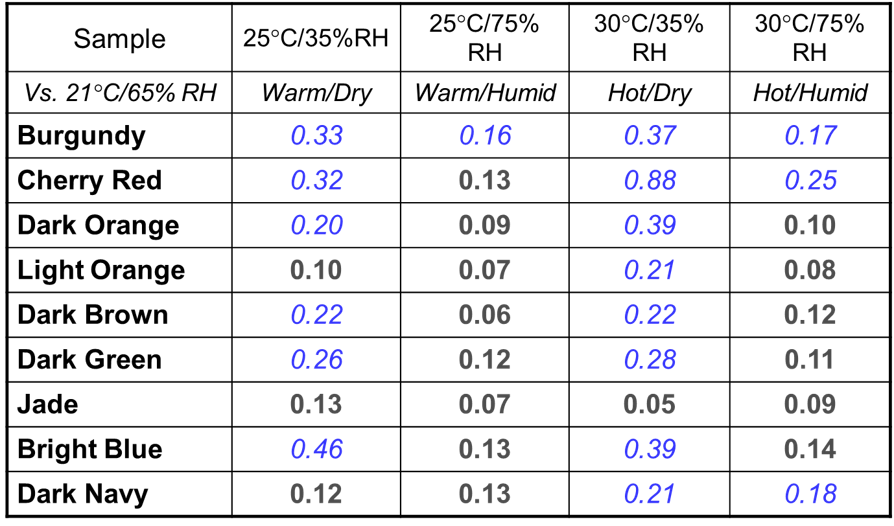
Competitor’s approach
Competitor’s benchtop spectrophotometers offer ambient sensors at max, no direct sample-condition reading, which can miss what’s happening on the sample surface.
“The DC1000 is a game changer; no more guessing if a user measured a specimen that had properly cooled to ambient temperature.”
— Dave Ertle, Advanced R&D Engineer, GEON Performance Solutions
2. Fleet confidence + backward compatibility
Datacolor Spectro 1000 Series has strong out-of-the-box inter-instrument agreement (IIA), with defined max specifications, and seamless backward compatibility within Datacolor benchtop fleets.
The reason for this is they all align to the same physical master within the same geometry— ensuring backward compatibility and consistency over time.
When you share digital standards across labs, plants, and suppliers, you want consistent results that remain defensible over time, not just “internally aligned” today.
The closer (or smaller) the inter-instrument agreement is, the more likely it is that your colors will be consistent across products, materials or locations.
“We are able to focus on more technical aspects of color matching
and development without having to worry if our instruments give us consistent readings.”
—Steve Foos, Assistant Vice President of Research & Development at American Colors
Optional Guardian monitoring can help maintain long-term confidence and consistency in how instruments perform over time.
Competitor’s approach
Competitor fleets require paid profiling or recurring alignment programs to harmonize instruments over time, particularly when mixing generations or expanding globally.
Other competitors use per-device calibration models. While this enables internal agreement, it may limit cross-device traceability — especially when comparing older and newer devices.
3. Throughput that scales
Datacolor Spectro 1000 Series offers faster measurement speed and improved throughput, including productivity gains with single-flash measurement, while maintaining performance. The proven time savings potential at scale, for example, at least a 25% reduction in measurement time versus prior generations, which can save over an hour per day at 1,000 measurements.
Competitor Benchmark
With competitors speed often depends on fixed “precision modes”, which can force trade-offs between throughput and spec performance.
4. Multi-site connectivity
Having USB and Ethernet connectivity, dynamic or fixed IP configuration, Datacolor Spectro 1000 Series can also be supported for Citrix and Terminal Server environments, which is especially relevant for global specifier accounts and distributed color teams.
Competitor’s approach
We see most competitors offering USB-only setups, with more limitations in multi-computer or multi-instrument environments, and less flexibility for remote and virtualized workflows.
5. On-instrument usability
The LCD interface of the Datacolor Spectro 1000 Series allows fast confirmation of measurement conditions, calibration status, and instrument details. The On-instrument sample preview support, helps operators position small samples more efficiently.
Competitor Benchmark
Sample preview is often on a PC screen, requiring the operator to look away from the sample during positioning, or we see it being offered as an added-cost option.
6. Serviceability and support designed to reduce downtime
Datacolor Spectro 1000 Series comes with 5-year extended warranty, designed to reduce total cost of ownership and operational disruption. It is also built for serviceability, with many parts replaceable in the field and strong options for on-site service, depending on region and configuration.
Competitor’s approach
In some regions and models, more service steps will require specialized tools, longer service times, or shipment to centralized service facilities.
The bottom line
If your priority is tight tolerances, consistent results across a supply chain, and fewer workflow compromises, Spectro 1000 stands out through configurability, sample-temperature confidence, fleet continuity, fast throughput, and practical deployment features that support real production environments.
|
Datacolor Spectro 1000
|
Comparable Benchtop Spectrophotometers
|
| • Measures sample surface temperature
• Supports heat-sensitive workflows
• Reduces “measured too soon” risk |
• Mostly ambient sensors at best
• No direct sample-surface reading
• Higher risk of condition-related variation |
| • Strong out-of-box inter-instrument agreement
• Aligns to a physical master
• Backward compatible across Datacolor fleets
• Optional Guardian monitoring |
• Often needs paid profiling/alignment programs
• Per-device calibration models are common
• Traceability can vary across generations/sites |
| • Faster measurement speed
• Single-flash productivity gains
• Proven time savings at high volumes |
• Speed tied to fixed precision modes
• Trade-offs between speed and performance
• Less predictable gains at scale |
| • USB + Ethernet
• Dynamic/fixed IP options
• Citrix/Terminal Server support |
• Often USB-only
• More limits in multi-instrument setups
• Less flexible for virtual/remote environments |
| • LCD for quick status confirmation
• On-instrument sample preview
• Fewer placement errors on small samples |
• Sample preview often PC-based
• Operator looks away during positioning
• Preview sometimes costs extra |
| • Included 5-year warranty
• Field-replaceable components
• Strong on-site service options (region dependent) |
• Service may require special tools
• More shipment-to-center scenarios
• Longer downtime in some regions/models |

 Want to Get Color Right?