From “expert intuition” to intelligent workflows, the newest color management shift in textiles
In textile production, color is still one of the fastest ways to lose time and margin, a lab match that doesn’t scale, a shade that drifts between plants, a print that looks right in one inspection lane but fails in another. What’s changing is how the industry is attacking these problems.
A recent systematic review of 101 research articles maps where “intelligent techniques” are delivering results across the textile color workflow, from recipe prediction to real-time inspection and even wastewater decolorisation.
The trend is not “more AI,” it’s smarter, task-specific AI
The research clusters into four practical hotspots, and each is converging on different toolsets.
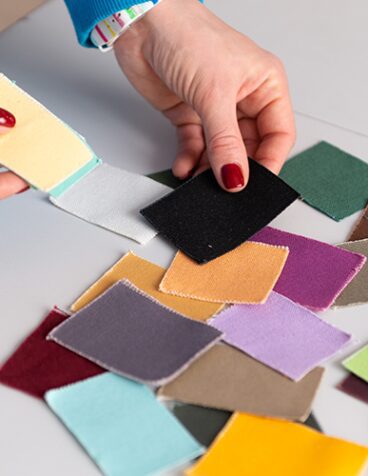
1) Better first-shot matches through learning-based prediction
For color matching and prediction, the dominant direction is neural-network-based modelling paired with optimization techniques that fine-tune performance and reduce error.
What’s notable is the movement toward hybrid approaches, combining learning models with optimization methods to improve accuracy and efficiency, not just “one model vs another.”
See how SmartMatch can improve a company’s first-shot color match rate by 80 percent
2) Faster, more automated color difference decisions
In color difference detection and assessment, research leans heavily into SVM variants and extreme learning machines, selected for speed and deployability, with optimization methods like DE and PSO frequently used to strengthen results.
There is also a clear push toward real-time inspection, including systems built around YOLO-style models for detecting defects and color differences at production pace.
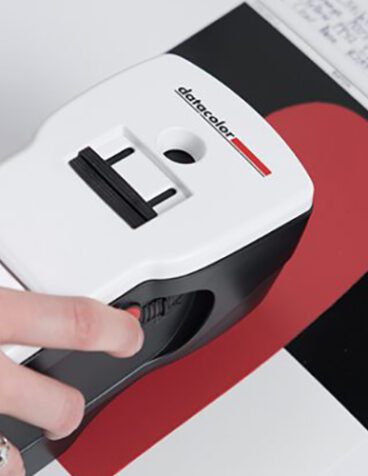
Datacolor Tools for QuickQC
3) Patterned and multicolor materials are driving segmentation innovation
For color recognition and segmentation, the “workhorse” remains clustering, but with smarter variants and pipelines that reduce compute time while improving robustness.
Some studies also show deep learning models trained with SVM methods delivering very strong classification performance, highlighting how segmentation is evolving beyond classic clustering alone.
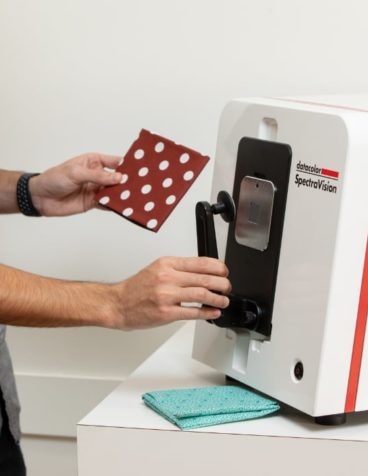
How Spectravision lets you measure patterned and multicolor materials
4) Sustainability workflows are becoming model-driven, too
In dye solution concentration and decolorisation, research is dominated by ANN and ANFIS, with RSM and GA often used to optimize processes and outcomes.
Importantly, the review emphasizes that performance rankings vary by data and application context, so “best model” depends on your process reality.
Key takeaways for color teams
- Digitize the workflow end-to-end. Intelligent methods depend on reliable measurement and consistent color data structures.
- Invest where it pays first. Prediction and color difference assessment are mature areas with proven modelling approaches.
- Plan for complex materials. Multicolor and patterned textiles are accelerating demand for segmentation and image-led approaches.
- Expect more hybrid systems. The momentum is toward combining models with optimization, and leveraging transfer learning to improve accuracy and efficiency.
If you’re reviewing your color strategy, the message is clear: the competitive advantage is shifting to teams that treat color as a measurable, connected, optimizable system, not a series of isolated checkpoints.
Contact our team to learn more about streamlining your company’s approach to color management.
Cited from the article https://rdcu.be/eYPk1
by Liu, S., Liu, Y.K., Lo, Ky.C. et al. Intelligent techniques and optimization algorithms in textile colour management: a systematic review of applications and prediction accuracy.
Based on a selection of 101 articles published from 2013 to 2022, this study systematically reviews the application of intelligent techniques and optimization algorithms in textile colour management.

 Want to Get Color Right?