We often encounter situations where the color difference data measured by a colorimeter is clearly within specifications, yet a naked-eye inspection reveals a noticeable color difference.
Here, we can start with the three primary color components to identify six major causes and explain the root of the discrepancy between instrument data and visual perception.
First Layer: Different Observation Light Sources
Colorimeters typically use standard light sources, such as D65, to calculate the DE value for color difference.
However, when actually viewing a sample, the environment may involve office fluorescent lighting, LED light boxes, or natural light from a window.
Since different light sources have different spectral compositions, the colors perceived by the naked eye will vary; however, the instrument does not account for the actual on-site lighting conditions and continues to calculate based on a standard light source, resulting in measurement errors.
Second Issue: Non-uniform Color Space
The CIE Lab color space assumes that the entire space is uniform—that is, ΔE = 1 represents the same visual difference in any region. However, the human eye is far from uniform. For example:
- Dark blue or dark purple areas: ΔE = 1.0 may not appear noticeably different to the naked eye;
- Gray and low-saturation colors: ΔE = 0.3, where a noticeable visual difference may be present.
Third Level: Selection of Color Difference Formulas
The human eye’s sensitivity to changes in luminance, saturation, and hue varies greatly across different color regions, but the CIE Lab color space treats these three dimensions “equally,” resulting in DE values in neutral gray or blue regions that do not correspond to visual perception.
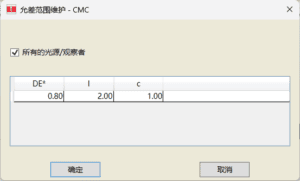
CMC and CIE2000 incorporate weighting corrections, yielding results that more closely align with human perception.
Many companies still use outdated formulas or do not align with the color difference formulas required by their clients; the textile industry generally requires the use of CMC (l:c=2:1).
Fourth Layer: Interference from Surface Physical Conditions
Take two pieces of fabric from the same dye lot: one is ironed flat, and the other is wrinkled. Their spectral reflectance is nearly identical, and the colorimeter reports a DE of approximately 0.1.
However, to the human eye, the wrinkled fabric appears darker and lighter in color because the wrinkles scatter the originally regular specular reflection into diffuse scattering in all directions, weakening the intensity of light entering the eye at specific angles,whereas the colorimeter’s integrating sphere (SCI mode) collects reflected light from all directions, measuring the “color itself” rather than the “visual appearance.”
This phenomenon is even more pronounced across different materials, such as paper color charts vs. fabric swatches, fabric swatches vs. yarn, cotton vs. polyester, and so on.
Even when the CMC DE is approximately 0.1, the visual differences between different materials remain significant.



Fifth layer: The hidden trap of metamerism
The two samples, using different dye formulations, showed similar Lab values under a D65 standard light source.
But don’t get too excited—this is likely just a “superficial phenomenon.”
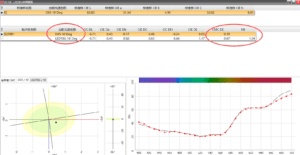
Once switched to an LED light source, different curves reflect the same light in different ways, instantly disrupting the originally balanced Lab value and making the color difference immediately obvious.
The CMC DE of the same batch of samples under different light sources was 0.39 under D65 and 0.67 under LEDT8G. The R% spectral curves were clearly separated. What’s more challenging is that many customers only require “viewing under natural light”, but the spectrum of natural light itself is different in the morning, noon and evening.
If metamerism exists, it’s like planting a time bomb—change the environment, and the result might be reversed.
The instrument reports a pass under D65 light, but the human eye judges it as a fail under LED light . This is the most common trap in the fifth layer.
Sixth layer: The human eye itself has subjective biases.
The human eye is not a precision instrument and is affected by fatigue, age, differences in color vision, adaptation to ambient light, and the effect of contrast between adjacent colors.
Even the same person will have different feelings when observing the same sample at different times.
Instrumental data is objective and reproducible, while visual judgment itself is subject to subjective fluctuations.
Summary of color knowledge
The values output by the instrument are objective results obtained under conditions of a fixed light source, a standard observer, and a selected color difference formula; the colors seen by the human eye are subjective perceptions under real lighting conditions.
The combination of six factors can lead to discrepancies between data and visual observation.
When encountering a discrepancy between the DE value and visual perception, do not immediately suspect the instrument. Instead, prioritize checking for metamerism, whether the color difference formula is correctly selected, and whether the measurement mode is suitable for the sample.


 Want to Get Color Right?