This blog post below is a republished copy of the original article, “Formulating for Sustainability,” first published by Plastics Technology (PTonline.com) on December 12. All editorial credit belongs to Plastics Technology.
You can read the original article here: Formulating for Sustainability (Plastics Technology)
Demand for the use of recycled plastics is growing, driven both by regulatory pressure and the influence of key global brands. Many of these goals are ambitious and some have been delayed by technical challenges, but they’re not going away.
Color management is often a challenge early on when dealing with recycled plastics and can potentially require adjustments throughout the entire production process. So many factors can cause variations in hue that consistency can never be taken for granted.
Fortunately, these additional complexities aren’t insurmountable. Digital color management can go a long way toward ensuring the final product meets any applicable brand or industry color standards. In addition, plastics manufacturers are developing a variety of strategies to incorporate and expand their use of recycled materials. Creative ideas can be found at every stage, from sourcing and processing to products and packages designed with the variability of recyclables in mind.
What’s Driving Demand?
Change in the plastics industry is frequently driven by governments, and the push for greater sustainability is no exception. Strict laws requiring higher amounts of recycled content have been enacted in Europe and ecoconscious American states such as New York, California and Oregon. Bans on single-use plastics are growing in many regions, while recycling efforts are ramping up in China, India and other parts of Southeast Asia. Although the strictest standards are only required in the EU and California, global brands that want to sell in those markets must follow them.
Any colorant in recycled plastic will complicate the color-matching process; there’s no way to filter it out.
At the same time, major brands like Adidas, Patagonia, Coca-Cola, Walmart and Amazon have made recycled plastics core pillars of their sustainability commitments, often creating a trickle-down effect among the small- and medium-sized partners who do business with them. Many industries, especially packaging, apparel and consumer goods, now see recycled content as essential, rather than optional.
As a result, suppliers worldwide are adjusting to meet these new norms, impacting pricing, availability and innovation in recycled plastics globally.
The Raw Materials
Most recycled plastics come from postconsumer packaging: the items we throw into recycling bins every day. The most reused types are polyethylene terephthalate (PET), commonly used to make beverage bottles, and high-density polyethylene (HDPE), found in products like milk jugs, shampoo bottles and some food containers.
It’s no coincidence that PET and HDPE correspond to the numbers 1 and 2, respectively, inside the recycling symbols stamped on the bottom of these items. They have well-established recycling systems and strong markets maintained by steady demand.
Other common plastics, like polyvinyl chloride (PVC), polystyrene (PS) and low-density polyethylene (LDPE — used to make plastic grocery bags), are harder to recycle. All are more likely to have contamination issues, and their resale value is lower, so they often end up in landfills instead.
Industrial waste, like scrap from factories, is a less common source, but it can also be recycled because it’s cleaner and easier to process.
Uses for Recycled Plastics
Companies are continually finding innovative ways to use recycled materials, particularly in industries such as fashion, consumer goods and packaging. Recycled plastics end up in all kinds of products, from new containers and clamshells to bottles and clothing, as well as furniture and even construction materials. PET from soda bottles is often turned into new bottles or spun into polyester fabric for clothing and shoes. HDPE from milk jugs can be used in plastic lumber, pipes or detergent bottles. Some recycled plastics are used in car parts, playground equipment and even 3D-printing filaments.
Building a colorant set requires a bit of effort, but it’s essential work that quickly will pay dividends when you use recycled materials.
A few industries — notably textiles and non-food packaging — have found ways to use 100% recycled content. This is rare, however, because fully recycled plastic can exhibit issues such as brittleness, discoloration or inconsistent melt flow, making it less reliable for many applications.
Most products use a blend of recycled and virgin plastic to maintain strength, ease of processing, and consistency in performance and color. The final mix depends on the quality of the recycled material, regulations and product performance requirements.
Inherent Variations Create Color Challenges
Any colorant in recycled plastic will complicate the color-matching process; there’s no way to filter it out. As a result, clear and untinted plastics are more likely to be reused and are in higher demand. Even without first-use colorants, recycled plastics often have slight hue variations caused by past uses or impurities. High temperatures can weaken the molecular structure of the polymer and cause discoloration. This thermal degradation is often unavoidable. For example, postconsumer water bottles typically become dull when they go through filtration or cleanup processes, requiring clarifying agents to restore them to their original appearance. Chemical additives, food residues, adhesives or other contaminants can also create color inconsistencies.
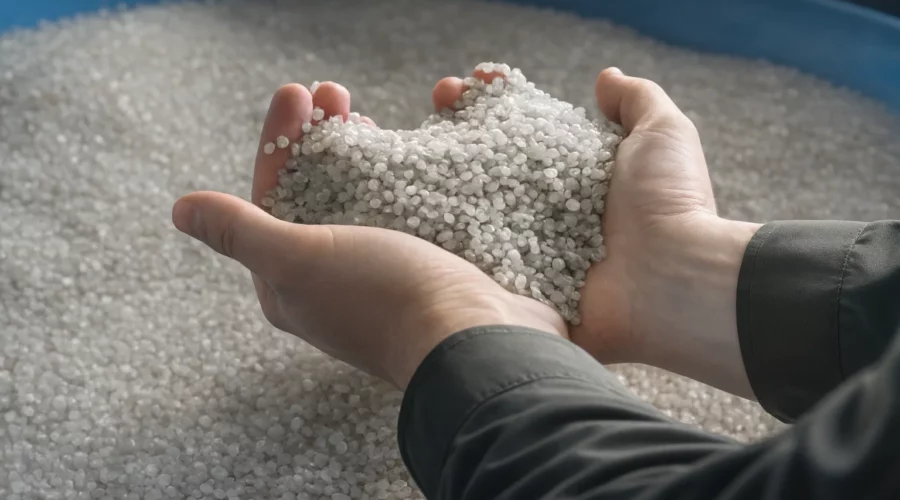
Recycled plastic may be more sustainable, but it’s rarely green — at least not in terms of its hue. Depending on how it’s processed, reclaimed resin often looks gray, yellow or brown. Gray is typically the result of mixing different-colored plastics together, creating a neutral tone. Yellowing is caused by heat and ultraviolet (UV) light exposure, which break down the polymer over time. Brown shades are usually caused by impurities, leftover dyes or oxidation.
Since it’s hard to get pure, clear, recycled plastic, manufacturers sometimes add pigments to even out the color or use these muted tones for products where appearance doesn’t matter. Colorants and additives can be mixed in during masterbatching to help offset inconsistencies, but the level of control depends on the quality of the recycled feedstock. For high-end applications like packaging or textiles, extra filtration and sorting steps are sometimes used to minimize color variation before compounding. Additional adjustments may be needed later in the process to ensure the final product meets brand or industry color standards, especially if the new mixture will be used for injection molding, extrusion or blow molding.
It’s important to note that color is just one aspect that must be considered. Other physical properties generally dictate the maximum proportion of recycled material and how much control you’ll have over the blend’s appearance. The color-matching process must often be balanced against the effects of any fillers, stabilizers, impact modifiers, UV inhibitors, lubricants or other additives.
Reliable Color Matching Starts at the Source
Recyclers go to a lot of effort to sort plastics by color and type before processing. Although manufacturers strive to establish the cleanest possible supply stream — preferably from a single source — perfect color uniformity is hard to find. Many variations still occur because of differences in feedstocks, especially in postconsumer products.
More consistent results are often possible with “reworked” material: plastic byproducts generated by a manufacturer’s own operations or sourced from another factory.
Masking Inconsistencies
Manufacturers can adjust colors with additives, dyes and blending techniques during production. The more uniform the source material, the fewer adjustments you’ll need to make.
Despite these efforts, recycled plastics rarely match the consistency of virgin materials. As a result, many brands use the minimum percentage of recycled material that meets regulations. Another common strategy is to use neutral or darker colors to hide imperfections. If a product doesn’t need to match specific brand colors, it may also be possible to incorporate the natural hues and variabilities of the recycled material.
Chemical Recycling Simplifies Color Management — For a Price
Most recycling is a mechanical process that involves collecting, sorting, shredding, washing and melting plastic to form new products. This often has undesirable impacts on color, making plastics look milky, dull or slightly grayish because of leftover dyes, impurities and heat degradation. As previously mentioned, this is especially noticeable in clear plastics like PET, which lose transparency and become cloudy.
An emerging alternative is chemical recycling, which uses solvents, depolymerization agents or other chemicals to break plastics down to its molecular level. This allows for much greater purity, with the tradeoff being higher costs. Chemical recycling can restore plastics to a near-virgin state, making color management much easier.
Use a Digital Workflow for Best Results
The key to color matching with recycled material is quantifying its color contribution. This is a complex and ongoing process that’s most easily handled with digital management tools.
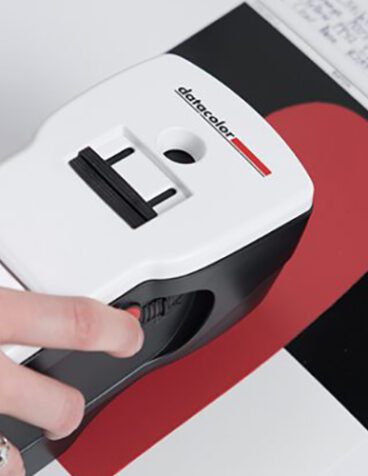
Manufacturers using this workflow measure each recycled material with a spectrophotometer, producing a reflectance curve that quantifies its unique color properties. This data can then be applied by formulation software using one or more recycled materials and additional pigments to match the desired final color.
Leading formulation packages have recycling functions that account for both color and other properties, enabling you to adjust for multiple factors. For example, adding titanium dioxide can enhance brightness while improving impact resistance and Mohs hardness.
If you’re completely new to digital color matching, you’ll need a spectrophotometer and formulation software that’s capable of managing the unique optical characteristics of polymers, additives and pigments. If you’re already using these tools with virgin plastics, it’s critical to make sure that your hardware, software and colorant sets are up to date. From there, it’s simply a matter of adding one, or more, new recycled materials to contribute to the color and accounting for the inherent variability.
Recycled plastic may be more sustainable, but it’s rarely green — at least not in terms of its hue.
Although pigment suppliers can help you develop your colorant sets, it’ll be best for your organization to produce them using its own machinery and laboratory equipment. This will ensure that you account for all the variations in polymers, pigments, additives and processes that could potentially impact the color. It’s also critical to update them when polymers, regulations, vendors or pigments change.
Building a colorant set requires a bit of effort, but it’s essential work that quickly will pay dividends when you use recycled materials. You’ll need to create a set of samples for each pigment, making multiple mixtures with white, as well as a mixture with black and/or masstone for each type of polymer you plan to measure, preferably using virgin material to establish baseline values. Once you have your samples, measure them with your spectrophotometer. Pigment concentrations can then be entered into the color-matching software to calculate the optical data, taking into account the pigment, polymer, film thickness, additives and so on.
This process should be repeated for every polymer family you work with, because the pigments will behave differently in each type. You’ll also want to measure any existing samples that have known pigment concentrations to validate your colorant set.
If you use a lot of pigments, it’ll be best to start with a limited number, perhaps the ones you know you’ll use most often or for a particular product line. You can expand the set once you’ve established the first group of pigments and validated the formulation results. Proper training is critical to achieving reliable results. Operators need at least a basic understanding of color theory, including color spaces like CIELAB or L*a*b* (lightness, red/green, yellow/blue axes) and different metrics like Delta E (∆E), metamerism and opacity. They’ll also need practical training in whatever formulation software they’re using. Datacolor Colibri software, for example, typically requires about three days of training for an operator with some previous color background — longer if they require an introduction to color theory. Operators who aren’t yet familiar with color management should consider starting with quality control software to build confidence and expertise before taking on full formulations.
Establishing a digital workflow can be complex, but it’ll be well worth it if you plan to work with recycled materials regularly. A well-tuned color-management system can help you achieve more precise color matches, despite the inherent variations of recycled materials. A good software suite will also streamline the process of finding the right balance between virgin and recycled materials while helping you evaluate which color results can be achieved with any given combination.
ABOUT THE AUTHORS: In his role as a senior applications engineer at Datacolor, Earl W. Balthazar III is responsible for software applications for clients. He has been with the company for more than 20 years. With 40 years of experience in color matching and quality assurance, Balthazar is the subject matter expert in Datacolor’s color-management software applications and custom solutions.
For more than 30 years, Rik Mertens has been an integral part of Datacolor. As the subject matter expert for the paint and coatings industry and the applications specialist for all Datacolor software, he knows the ins and outs of managing color throughout the supply chain. Mertens works with global key accounts in the PCS industry to define and implement color management solutions tailored to their needs. He also collaborates with product managers and R&D to update and improve Datacolor software.

 Want to Get Color Right?