Have you ever experienced this kind of trouble:
- The color check is correct during production, but the customer complains about the color difference after receiving the goods?
- The color chosen by the designer is completely changed on the production line?
- The same batch looks like two colors in different light?
It’s probably not your eyes, but the light source that’s “tricking” you!
When the same set of objects is viewed under different light sources, the colors can vary significantly – this is known as the ” homochromatic effect ” in color management. To solve this problem, the most effective way is to use a standard colorimetric light box, color assessment under controlled conditions. Today we will dismantle the standard use of colorimetric light boxes in detail.
Environmental requirements
All will have the opportunity to irradiate in the test article on the external light must be avoided, such as windows in the field of vision, in addition, should be installed on the gray curtains to avoid, so the use of colorimetric light box in the dark room is the most ideal. There is also a point that is often overlooked, that is, the colorimetric light box should never be placed in other sundries as well as the color of the person’s clothing should not wear brightly colored clothing.
operational requirement
viewing angle
The above points are the necessary facilities for a standard colorimetric light box, except for the viewing angle, which also has a direct impact on the evaluation results. According to international standards, there are only two viewing angles that can be used and they are:
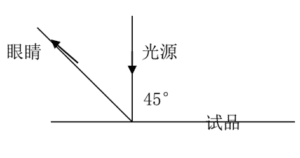
A. Zero-degree light source, 45-degree view (0°/45°)
This means that the light source shines on the specimen from a zero-degree (vertical) angle of incidence, and the observer observes the specimen from 45 degrees.
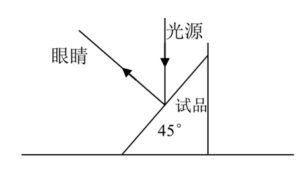
B. 45-degree light source, zero-degree viewing (45°/0°)
In this layout, a specific 45-degree inclined table is used, with the light source illuminating the specimen from 45 degrees and the observer viewing the specimen from zero degree (vertical).
Specimen placement
Regardless of the use of any of the above observation methods must be noted that the test specimens should be placed in the middle of the light box as far as possible, in order to reduce the impact of the external light source. In addition, the most important thing is that in the need to compare two or more pieces of color, should also try not to overlap them to watch, it is best to be placed side by side in the light box comparison.
Care and Maintenance
A. Daily use
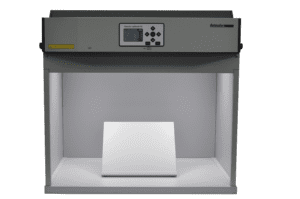
- A clean and tidy light box is the most basic requirement to ensure our color accuracy.
B. Periodic calibration
- Calibrate and measure all lamps with a spectrometer. Ensure proper light distribution inside the light box – The sidewalls of the light box will show color degradation, stains, and chips from use. This can affect the light distribution inside the light box and ultimately affect your evaluation results.
- Illumination Detection – Ensures that the illumination in all areas is uniform and up to standard.
- Box Inspection – Test the interior walls for color degradation and staining.
- Consistency verification: performance consistency comparison between multiple light boxes.
C. Standardized test reports
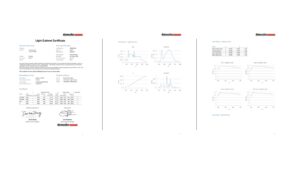
A standard light box test report should contain the following test results:
- Light box surface paint test whether to meet the standards (paint surface staining, damage are not in line with the requirements):
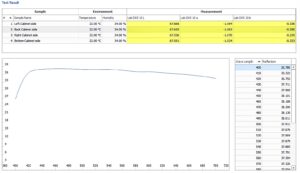
- The color temperature and illuminance of each light source meets the standard (each light source needs to be within the standard color temperature and illuminance range to meet the standard):
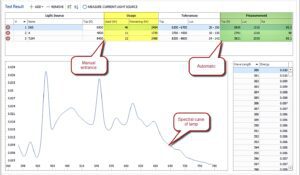
- A standard test report should contain the following points:
- Detecting the date of the light box
- Signature of Testing Engineer
- Detect the model serial number of the light box
- Serial number of the equipment used for testing
- Factory name and address contact person
- Whether the light box surface paint test in the qualified range
- Light box light source category and test data is in the standard range
Special note: These mistakes are the most common!
Mistake #1: Storing samples or miscellaneous items inside the light box for long periods of time.
Mistake 2: Operating in brightly colored clothing such as red and yellow.
Mistake #3: Using light boxes in environments where natural light interferes.
Mistake 4: Lamps are overdue for replacement.
Mistake 5: Multiple samples are compared overlapping rather than side-by-side.
Suggestions for Selection and Use
Equipment Selection PointsStandard Compliance: Ensure that the equipment complies with international standards such as ASTM D1729.
Light source quality: focus on the color rendering index and stability of the lamp.
Switching performance: Must support instantaneous switching between light sources.
After-sales service: The supplier shall provide regular calibration and technical support.
Advanced Tips
For users who need higher accuracy or special applications:
Adjustable Illumination Light Box: such as Datacolor PS & ES series, to meet the special needs of different materials.
LED Upgrade Program: Compared with traditional fluorescent lamps, LED light sources have more advantages in stability, lifetime and energy efficiency.
summarize
The accuracy of color assessment is three parts equipment and seven parts use.
A standard colorimetric light box, with the correct use of methods and regular maintenance and calibration, in order to truly become your color quality control of the “guardian angel”.
Remember this core formula: standard equipment + correct environment + standardized operation + regular maintenance = reliable color assessment


 Want to Get Color Right?