12 Frequently Asked Questions About Color Management Instruments
Choosing the right solution
Share
Want to Get Color Right?
Get on the Right Color Management Wavelength with Monthly Insights from 10,000+ Color Professionals Around the World.
Color management instruments help companies measure, evaluate, communicate and control color with objective data. For color-critical industries, this matters because visual judgment alone can lead to inconsistent approvals, supplier disputes, rework, waste and customer complaints.
Whether your team works in textiles, plastics, paint and coatings, cosmetics, paper, packaging or retail paint, the right color measurement workflow can improve consistency, speed and confidence in quality decisions.
This FAQ answers common questions about color management instruments, including spectrophotometers, colorimeters, metamerism, Delta E tolerances, calibration, instrument maintenance and multi-site color control. For a broader foundation, see digital color management and color management solutions.
1. Do I Really Need a Color Measurement Instrument?
Yes, if color consistency affects product quality, customer approval, brand appearance or production efficiency, a color measurement instrument is essential.
Human vision is useful, but it is subjective. People do not all see color the same way. Visual perception can be influenced by light source, background, viewing angle, age, fatigue, medications, memory, mood and surrounding colors.
In professional color control, subjective evaluation can create risk. Two people may disagree on the same sample. A supplier may approve a color that a customer rejects. A product may look acceptable in one environment but fail in another.
Color measurement instruments help teams create objective color data. This makes it easier to compare samples against standards, define tolerances, document approvals and communicate color differences clearly.
A material may be metameric if it matches another sample under one light source but looks different under another.
Metamerism occurs when two samples appear to match in one lighting condition even though their spectral curves are different. This can happen when different dyes, pigments, substrates or materials are used to create the same target color.
There are two common ways to evaluate metamerism:
Visual Evaluation in a Light Booth
Compare the standard and sample under a primary light source, then review them under one or more secondary light sources. If they match under one light source but differ under another, metamerism may be present.
Instrumental Evaluation With a Spectrophotometer
A spectrophotometer can measure spectral reflectance data and evaluate the samples under different illuminant and observer combinations. If the spectral curves differ significantly, the samples may be metameric even if they match visually under one condition.
3. What Are the Different Types of Color Measurement Instruments?
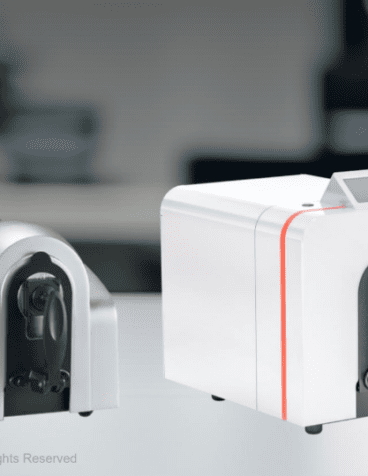
The main types of color measurement instruments include benchtop spectrophotometers, portable spectrophotometers, colorimeters and specialized devices for specific sample types or workflows.
Each instrument type serves a different purpose:
Benchtop Spectrophotometers
Benchtop instruments are typically used in labs and controlled environments. They are designed for high precision, repeatability and quality control. They are often used to create standards, support formulation and approve production samples.
Portable Spectrophotometers
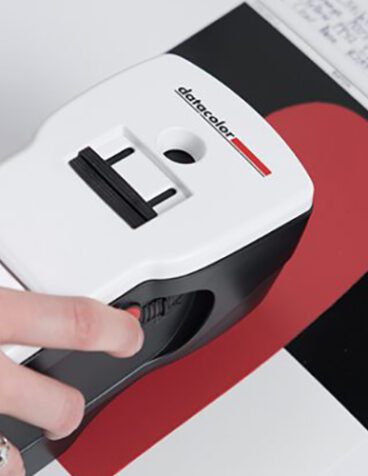
Portable instruments can be used in production areas, supplier sites, retail environments or the field. They are useful when samples cannot easily be moved to a lab or when faster on-site measurement is needed.
Colorimeters
Colorimeters provide objective color comparison using filtered light that approximates human visual response. They are often useful for simpler color checks, but they do not provide the full spectral data of a spectrophotometer.
Specialized Instruments
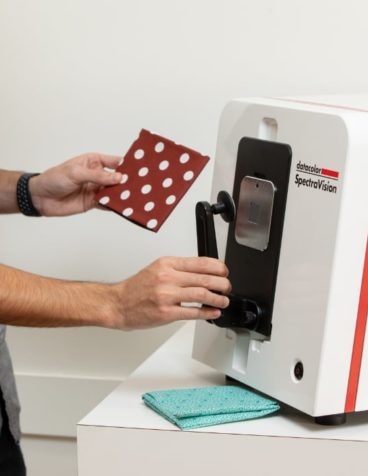
Some instruments are designed for nontraditional or complex samples, such as small objects, patterned materials, textured surfaces, lace, trims, hair samples or multi-colored materials.
4. Are Colorimeters and Spectrophotometers the Same Thing?
No. Colorimeters and spectrophotometers both measure color, but they do it differently and provide different levels of data.
A colorimeter simulates human vision by measuring color through red, green and blue filters. It can be useful for straightforward color comparison, especially when the application does not require full spectral detail.
A spectrophotometer measures reflected or transmitted light across the visible spectrum. This produces more complete color data, including spectral reflectance curves. Spectrophotometers are typically preferred for color-critical workflows because they support formulation, tolerance evaluation, metamerism analysis and more advanced quality control.
In simple terms:
A colorimeter helps compare color.
A spectrophotometer helps measure, analyze and manage color more deeply.
Yes, but you need the right instrument for the sample and the measurement objective.
Traditional instruments are often designed to measure a single, uniform area at a time. That works well for many flat, consistent materials. However, some samples are visually complex or difficult to measure with standard methods.
Examples include:
buttons;
gems;
hair samples;
patterned materials;
lace;
trims;
textured fabrics;
small 3D objects;
samples with shadows or surface variation;
multi-colored materials.
Datacolor SpectraVision is designed to measure a range of nontraditional samples and capture color data from complex surfaces more effectively than conventional single-point measurement workflows.
6. How Do I Determine How Close of a Match I Need?
You determine the required color match by setting a Delta E tolerance that reflects customer expectations, product risk, material type, application and production capability.
Delta E describes the color difference between a standard and a measured sample. But there is no universal tolerance that works for every product. A tolerance that is acceptable for one material or color family may be too loose or too strict for another.
When setting Delta E tolerances, consider:
the quality demands of your customers;
agreement between instrumental data and visual assessment;
the Delta E formula being used, such as CIEDE2000 or CMC;
the color family, including whites, pastels, neutrals, deep colors and high-chroma colors;
the visibility and business risk of the product;
the color accuracy of competing products;
production speed and available correction resources;
the cost-benefit balance of tighter color matching.
A tolerance should be strict enough to protect quality, but realistic enough to support efficient production and approvals.
7. My Instrument Readings Are Not Consistent. What Could Be Wrong?
Inconsistent readings can be caused by sample variation, surface effects, poor sample preparation, instrument setup, calibration issues or environmental conditions.
If the sample is irregular, textured, glossy, patterned or non-uniform, different measurement locations may produce different results. In this case, measure the sample multiple times, rotate or reposition it between readings and average the results.
Other common causes of inconsistent readings include:
inconsistent sample thickness;
different measurement locations;
poor sample conditioning;
surface gloss or texture variation;
incorrect backing;
instrument calibration issues;
dirty calibration tiles;
temperature or humidity variation;
an unstable measurement environment;
operator technique differences.
The first step is to determine whether the variation comes from the instrument, the sample or the measurement procedure.
8. What If I Have Multiple Company Locations Measuring Color?
If multiple locations measure color, standardization is critical. Teams need aligned instruments, procedures, standards, software settings and maintenance routines.
Whether you have three locations or 30, consistent color data depends on a controlled workflow. If each site uses different instruments, measurement settings or sample preparation methods, the same sample may produce different results.
To improve multi-site consistency:
Use the same or similar instruments where possible.
Maintain instruments according to manufacturer specifications.
Calibrate regularly.
Control temperature and humidity.
Store and measure standards consistently.
Use documented measurement procedures.
Monitor each instrument’s variation from the standard.
Choose close-tolerance instruments for high-precision workflows.
Review instrument performance across the fleet.
Inter-instrument agreement is especially important when labs, suppliers and production sites need to make the same color decision from different locations.
9. How Long Can I Expect My Spectrophotometer to Last?
A spectrophotometer can last for many years, but its accuracy, serviceability and compatibility should be reviewed over time.
Instrument performance does not usually decline overnight. It may shift gradually, which makes issues harder to detect until color quality, approvals or production consistency are affected.
You may need to evaluate replacement or trade-in if:
the service contract has expired;
the instrument no longer meets your tolerance requirements;
maintenance issues are increasing;
it does not align well with newer instruments;
software or operating system compatibility is becoming difficult;
measurement repeatability has declined;
the instrument is no longer supported;
your workflow now requires higher precision or new capabilities.
10. How Do I Know If My Instrument Needs Maintenance?
Your instrument may need maintenance if calibration warnings appear, readings become inconsistent, repeatability declines or the instrument no longer meets certification requirements.
Some Datacolor instruments, including the Spectro 1000 and Spectro 700 instrument families, provide on-screen status indicators for maintenance.
General status indicators may include:
Green: the instrument is operating normally.
Orange: maintenance or tile replacement may be needed soon.
Red: the white tile or instrument is no longer certified.
During white tile calibration, similar indicators can help determine whether the calibration tile or instrument requires attention.
Beyond on-screen alerts, teams should follow the manufacturer’s maintenance and testing recommendations. This includes regular calibration, cleaning, temperature and humidity control, calibration tile care and periodic service.
11. Do I Really Need to Calibrate My Spectrophotometer?
Yes. Regular calibration is essential for accurate and consistent spectrophotometer measurements.
A spectrophotometer’s photometric scale is calibrated to specific standards. Routine calibration helps ensure that measurements remain aligned with those standards. Without calibration, readings can drift and color decisions may become unreliable.
Calibration is especially important when:
tolerances are tight;
multiple instruments are used;
samples are measured across different locations;
measurement data is shared with suppliers or customers;
production approvals depend on pass/fail decisions;
the instrument is used daily;
auditability is required.
Calibration tiles are also part of the measurement system. They must be handled, stored and cleaned correctly to maintain reliable readings and support inter-instrument agreement.
12. Are There More Affordable Solutions for Matching Color?
Yes. More affordable color matching tools may be suitable when the workflow requires practical color identification rather than advanced lab-grade quality control.
For example, ColorReader Spectro is a portable spectrophotometer designed to support fast and practical color matching in retail paint and related workflows. It is handheld and Bluetooth-connected, making it useful where quick color identification is needed.
However, affordability should be balanced against workflow requirements. A lower-cost tool may be appropriate for retail color lookup, but tighter industrial tolerances may require more advanced spectrophotometers, software and controlled measurement procedures.
When choosing an instrument, consider:
required color accuracy;
sample type;
tolerance requirements;
measurement environment;
the need for spectral data;
reporting requirements;
supplier or customer specifications;
whether the instrument must support formulation or quality control workflows.
How to Get Better Results From Color Management Instruments
Getting strong results from color management instruments depends on the full workflow, not only the instrument itself.
To improve color measurement quality:
define clear color standards;
use the right instrument for the sample and application;
calibrate regularly;
maintain calibration tiles;
prepare samples consistently;
measure in stable environmental conditions;
use controlled visual evaluation where needed;
define tolerances clearly;
document standard operating procedures;
align suppliers and sites;
review measurement data over time.
A structured color quality control program helps turn instrument data into better business decisions. It can reduce rework, support faster approvals, improve supplier alignment and strengthen product consistency.
How Datacolor Supports Color Measurement Workflows
Datacolor offers color measurement instruments, software and services for companies that need reliable color data across design, development, production, quality control and supply chain communication.
formulation software for color recipe development and correction;
visual evaluation tools for controlled light assessment;
specialized instruments for complex samples;
support and services for instrument care and workflow improvement.
Still Have Questions About Color Management Instruments?
Understanding your color management instruments helps you improve measurement quality, productivity, budget efficiency and confidence in color decisions.
If your team is dealing with inconsistent readings, unclear tolerances, supplier disputes, aging instruments or uncertain workflow requirements, Datacolor can help you evaluate your current process and identify the right measurement approach.


 Want to Get Color Right?