What Is Light? An Introduction to Human Color Vision
Color science
Share
Want to Get Color Right?
Get on the Right Color Management Wavelength with Monthly Insights from 10,000+ Color Professionals Around the World.
Light is a form of energy that travels through space as electromagnetic waves. It is one of the fundamental building blocks of how humans experience and understand the world around them.
Although light is only a small portion of the electromagnetic spectrum, it is the only part visible to the human eye. Without light, human color vision would not exist.
Understanding how light works—and how humans perceive it—is essential to understanding color science, color measurement, and color management.
The Electromagnetic Spectrum and Visible Light
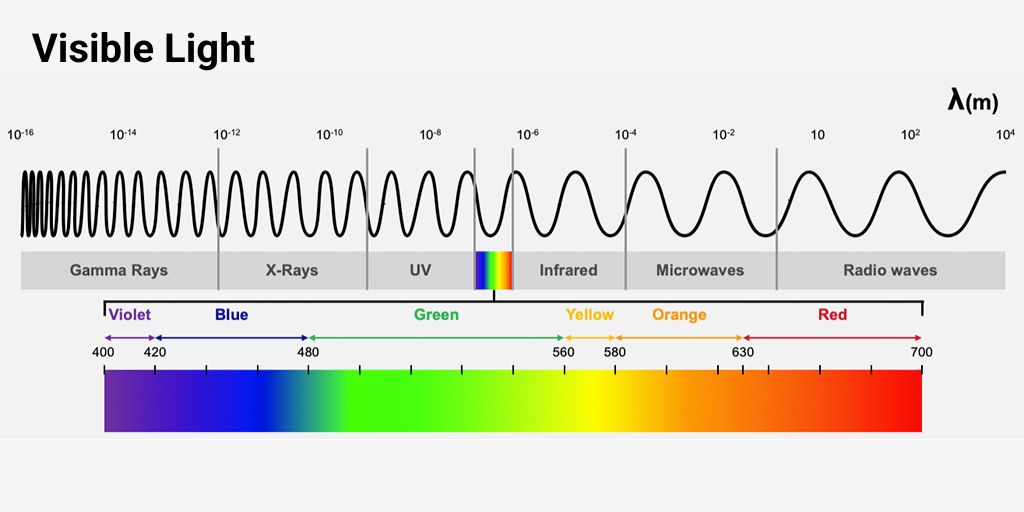
The electromagnetic spectrum includes a wide range of energy wavelengths, from gamma rays and X-rays to radio waves.
Humans can only see a small portion of this spectrum known as the visible spectrum or visual spectrum.
The typical human vision range spans approximately:
400 nanometers (nm): violet light
700 nanometers (nm): red light
This range is often referred to as the human vision spectrum or human eye color spectrum.
Everything we perceive as color exists within this relatively narrow band of wavelengths.
Outside of this visible range, light still exists, but it cannot be detected by the human eye without specialized instruments.
What Wavelengths Can Humans See?
Humans generally see wavelengths between approximately 400 and 700 nanometers.
Color Region
Approximate Wavelength
Violet
400–450 nm
Blue
450–495 nm
Green
495–570 nm
Yellow
570–590 nm
Orange
590–620 nm
Red
620–700 nm
The exact range can vary slightly from person to person, but most individuals perceive light within this spectrum.
This visible range represents only a tiny fraction of the total electromagnetic spectrum.
Human color vision begins when light enters the eye and reaches the retina.
Inside the retina are specialized photoreceptor cells that convert light energy into signals that the brain can interpret.
These photoreceptors allow us to perceive:
brightness;
contrast;
motion;
color.
Color perception is made possible by cone cells, which respond to different portions of the visible spectrum.
Tri-Chromatic Color Vision
Humans typically have three types of cone photoreceptors.
These cones are sensitive to:
short wavelengths associated primarily with blue;
medium wavelengths associated primarily with green;
long wavelengths associated primarily with red.
Because of these three cone types, human vision is described as tri-chromatic color vision.
Rather than detecting every wavelength individually, the brain combines signals from these cones to create the rich range of colors we experience every day.
This process allows the average person to distinguish millions of colors from just three primary color responses.
The relationship between light and color is inseparable.
Without light, there is no color.
When light strikes an object:
Some wavelengths are absorbed.
Some wavelengths are reflected.
The reflected wavelengths enter the eye.
The brain interprets those wavelengths as color.
For example, a red object appears red because it reflects more long wavelengths while absorbing much of the rest of the visible spectrum.
Understanding this interaction between light and matter forms the foundation of modern color science.
Why Human Color Vision Matters in Manufacturing
Human color perception is remarkable, but it is also subjective.
For industries where color consistency is critical, relying solely on visual assessment is not enough.
Industries such as the following must produce colors that remain consistent regardless of who evaluates them:
Textiles
Plastics
Paint and coatings
Cosmetics
Printing
Packaging
This is why manufacturers rely on objective color measurement tools.
Using spectrophotometers and digital color management systems, companies can quantify color based on measured light reflectance rather than individual perception.
The science of color measurement is built upon our understanding of:
light;
the visible spectrum;
human color vision;
color perception.
By understanding how humans see light and color, manufacturers can develop more accurate methods for communicating, measuring and reproducing color throughout the supply chain.
Digital color management transforms subjective visual observations into objective numerical data, helping companies achieve consistent color quality from design through production.
Frequently Asked Questions About Human Color Vision
What is the visible spectrum?
The visible spectrum is the portion of the electromagnetic spectrum that the human eye can detect. It generally extends from approximately 400 nanometers for violet light to 700 nanometers for red light.
What wavelengths can the human eye see?
Most people can see wavelengths between roughly 400 and 700 nanometers. The precise range varies slightly between individuals.
Why is human vision called tri-chromatic?
Human vision is described as tri-chromatic because the retina contains three primary types of cone cells that respond most strongly to short, medium and long wavelengths.
How does the eye perceive color?
Light reflected from an object enters the eye and stimulates cone cells in the retina. The brain combines the resulting signals and interprets them as color.
Why do people perceive colors differently?
Color perception can vary because of age, genetics, eye health, color vision deficiencies, lighting conditions, surrounding colors, fatigue, experience and expectations.
What is the difference between light and color?
Light is electromagnetic energy. Color is the visual experience created when the eye and brain interpret different wavelengths of visible light.
Why is visual color evaluation not always reliable in manufacturing?
Visual evaluation is subjective and can be influenced by lighting, fatigue, observer differences and surrounding colors. Manufacturers therefore combine controlled visual assessment with objective spectrophotometer measurements.
How does a spectrophotometer support color measurement?
A spectrophotometer measures how a sample reflects light across different wavelengths. The resulting data allows manufacturers to compare colors objectively, set tolerances and control color consistency.
Want to learn more about color science?
Get a copy of Datacolor’s Fundamentals of Colorimetry eBook to explore color perception, color measurement, color spaces, spectrophotometers and digital color management.


 Want to Get Color Right?