The industry went digital. The next step is connected. Here’s what that means.
By Mathieu Bonenfant, Director of Product Management, Datacolor
When I joined Datacolor, I came from the broader textile technology space. I’d spent years working on manufacturing and supply chain challenges. What struck me immediately about color management was how much precision the industry had achieved, and how little of it was connected.
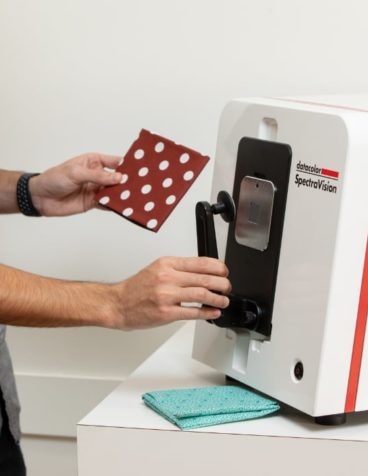
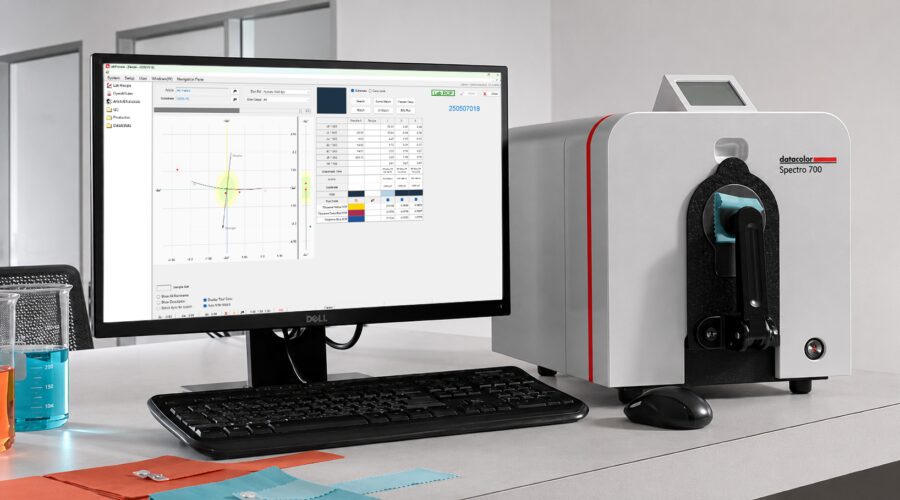
Many labs I visited have spectrophotometers. They have formulation software. They have dispensing systems. The days of matching color purely by eye under inconsistent lighting are fading. Datacolor has been part of this journey for over 50 years.
But here’s what I keep hearing from nearly every lab I walk into: “We have the tools. They just don’t talk to each other.”
A colorist formulates a recipe in one system. That recipe gets manually re-entered into the ERP (enterprise resource planning) system. The dispenser runs its own software. The spectrophotometer stores measurements locally. Every handoff is a chance for error, delay, or lost data. And when an experienced colorist leaves, the knowledge they carried goes with them.
These labs are digital. But they’re not connected.
What disconnected digital tools are costing textile manufacturers
The cost shows up in places most businesses don’t track. A recipe transcribed wrong into the ERP. A completed job whose results never reached the brand’s system, stalling approval for days. A correction round that wouldn’t have been needed if production had access to the original lab data.
Added up across thousands of jobs a year, these gaps become a significant drag on development time, on-time delivery, and margin.
There’s a sustainability cost too. Every avoidable correction round is water not used, chemicals not wasted, energy not consumed. Eliminating those rounds at scale is one of the most practical sustainability levers in textile manufacturing today.
What is connected color intelligence?
Connected color intelligence is what happens when the precision the textile industry already trusts becomes connected across systems, equipment, and partners. It’s not a product. It’s a concept, and a direction: the next evolution of digital color management.
In practical terms, it starts in the textile color lab. When formulation software, spectrophotometers, dispensing equipment, and business systems (ERP, MES) operate as one workflow, the lab fundamentally changes. Data enters once and flows everywhere it needs to go. Recipes are informed by formulation history, not just theoretical calculations. Job management happens in real time.
The results are measurable. Lianfa Textile shortened development cycles by 30% and improved on-time completion by 15% after connecting their lab operations with Datacolor Textile Lab Manager. Yangzi now hits target color in one or two attempts and has cut yarn delivery to under a week.
These aren’t incremental improvements. They’re step changes in how a lab performs.
Why does connected color management matter beyond the textile color lab
Color doesn’t stop at the lab door. A recipe that’s perfect at lab scale needs to perform at production volume. Production quality needs to be visible to the brand that specified the color. And yet, most brand-supplier color communication still runs on emails, shared folders, and attachments that go out of date the moment they’re sent. Approvals that should take days take weeks. Correction rounds multiply because suppliers didn’t have the right specifications or tolerances from the start.
The impact scales with every stage you connect. In the lab, manufacturers like Lianfa and Yangzi are already proving that. As we extend connected color intelligence beyond the lab, we see the potential for meaningful gains: less time spent on manual steps as quality control and reporting become embedded in the workflow, fewer physical sample shipments as digital submissions replace costly courier rounds, and faster paths to market as real-time visibility replaces the waiting that slows every approval cycle.
And there’s a sustainability dimension that shouldn’t be overlooked. Every sample round you eliminate is a shipment that doesn’t happen, chemistry that doesn’t get used, and rework that doesn’t consume water and energy. When you improve the workflow, you improve the footprint. They’re the same thing.
Having come from the supply chain side of textile technology, this is the gap that stands out most to me. The industry has invested heavily in precision at each stage. What it hasn’t done is connect those stages together. The next era of color management will be defined by how well the lab, production, and supply chain connect, with data that flows, systems that learn, and partners that can trust what they’re seeing.
Why is the textile industry ready for connected color intelligence now?
Part of the answer is that the technology has matured. Reliable ERP and MES integration, AI-powered formulation that learns from production data, and instruments with the inter-instrument agreement to make shared data meaningful across locations are all here now.
But the bigger driver is that the industry can no longer afford not to connect. Supply chains are fragmenting across new geographies as tariffs shift. Brands are adding suppliers in countries where they’ve never sourced before. Lead times keep compressing. And sustainability requirements are moving from voluntary to regulatory, with the EU Digital Product Passport requiring digital traceability by the end of the decade.
A lab full of excellent but disconnected tools isn’t enough anymore. The manufacturers that will win the next decade’s business are the ones whose precision is connected, whose data flows, and whose operations can prove it.
What comes next for Datacolor
I’ve shared where we’re starting. I haven’t shared everything that’s coming. The textile color lab is the foundation, not the destination. Datacolor’s vision for connected color intelligence extends across the entire textile color chain, and we’ll have more to share soon.
For now, I’d encourage anyone in the industry to ask themselves one question: your lab has the tools, but are they connected?
If the answer is no, that’s where to start.
Ready to connect your lab? See Datacolor Textile Lab Manager
See the results. How Lianfa shortened development by 30% | How Yangzi hits color in one try
Have questions? Talk to a Datacolor specialist

 Want to Get Color Right?