Get on the Right Color Management Wavelength with Monthly Insights from 10,000+ Color Professionals Around the World.
By Ken Butts, Global Key Account Team Manager at Datacolor
Designers and colorists know that fluorescent colors can be some of the most challenging shades to reproduce consistently. Yet fluorescent colors remain incredibly popular across industries because of their visual impact and ability to attract attention.
From sportswear and swimwear to safety apparel, footwear and fashion accessories, fluorescent colors help products stand out in crowded retail environments and create a strong visual identity.
The challenge is that fluorescent color matching follows a different set of rules than traditional color matching.
Understanding why fluorescent colors behave differently is the first step toward achieving consistent results throughout the supply chain.
Why Fluorescent Colors Are Different
Most conventional colors become darker as additional dye or pigment is added to a substrate.
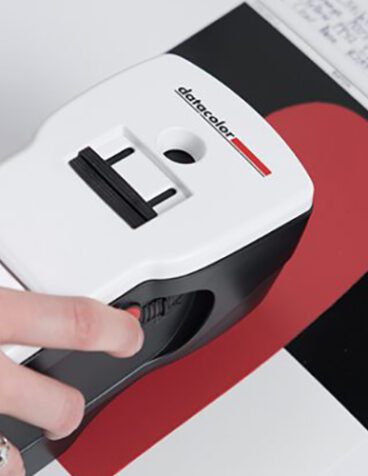
These color changes can be measured accurately using a spectrophotometer, which captures the amount of light reflected from a material across the visible spectrum.
The resulting reflectance curve acts as a unique fingerprint for the color, making accurate color matching and quality control possible.
Fluorescent colors behave differently.
Instead of simply reflecting visible light, fluorescent dyes absorb ultraviolet (UV) energy and re-emit it as visible light. This process makes fluorescent colors appear brighter, more vibrant and more intense than conventional colors.
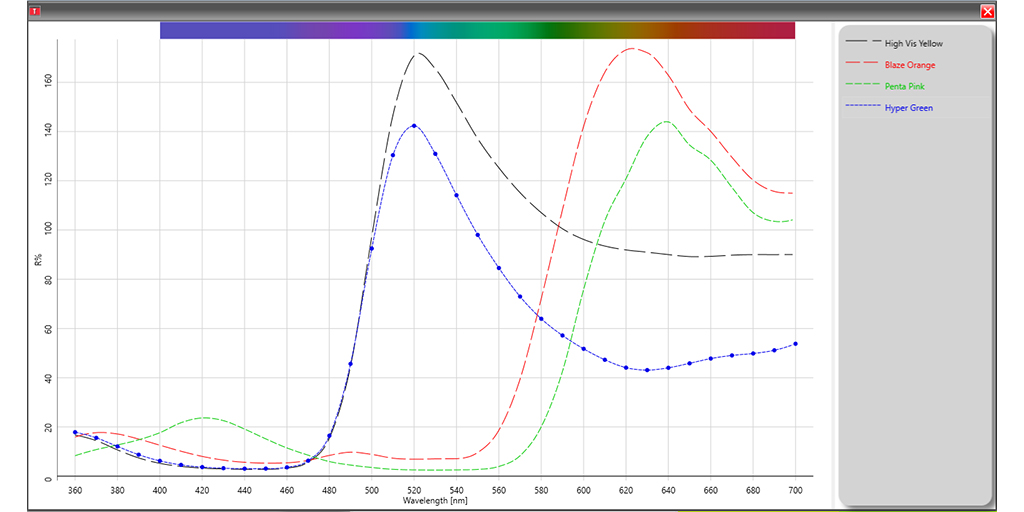
Figure 1: Reflectance Curves of Fluorescent Colors
Figure 1: Example of reflectance curves for four fluorescent color samples.
Because fluorescent materials emit additional visible light, their reflectance values can exceed 100%.
This is not a measurement error.
It is evidence that the material is converting invisible UV energy into visible light, creating the brilliant appearance that makes fluorescent colors so attractive.
Traditional color matching systems are built around predictable relationships between dye concentration and color appearance.
Fluorescent dyes introduce additional variables that make this relationship much more complex.
Common challenges include:
Variations in UV content between light sources
Different substrate behaviors
Limited dye compatibility
Reduced formulation flexibility
Greater sensitivity to process variation
Metamerism under different lighting conditions
As a result, a fluorescent color that appears correct in one environment may look noticeably different in another.
According to Kristen Bell, Manager of Color Development at Carhartt:
“The hardest part about fluorescents is setting expectations with designers and merchandise partners in terms of what is feasible.”
“Design loves them because of the lift they provide to the floor and they’re eye-catching for the consumer. But not all substrates can match to our standards.”
The Role of UV Light in Fluorescent Color Perception
The appearance of fluorescent colors depends heavily on ultraviolet light.
Without sufficient UV energy, fluorescent colors lose much of their brightness and visual impact.
This creates a significant challenge during product development because not all lighting environments contain the same amount of UV energy.
Light Source
UV Content
Natural daylight
High
Daylight light booth
Controlled
LED lighting
Often lower
Office fluorescent lighting
Variable
Retail lighting
Variable
Because UV levels differ from one environment to another, fluorescent colors can appear inconsistent unless they are evaluated under controlled conditions.
Share digital color standards whenever possible to reduce ambiguity and accelerate approvals.
Achieving Better Fluorescent Color Matching
Fluorescent colors continue to attract consumers because of their brightness, energy and visual impact. However, achieving consistent fluorescent color matching requires a deeper understanding of UV energy, color perception and measurement science.
By combining UV-calibrated spectrophotometers, standardized workflows, controlled visual evaluation and digital color management, manufacturers can dramatically improve the accuracy and consistency of fluorescent color communication.
The result is faster approvals, fewer color corrections, less waste and products that meet both design expectations and production realities.
Improve Fluorescent Color Matching Across Your Supply Chain
Interested in improving fluorescent color measurement and color matching across your supply chain? Explore Datacolor’s color management solutions or connect with one of our color experts.


 Want to Get Color Right?