No, you cannot expect consistent results across different color spaces or color difference formulas unless the same system, formula, illuminant and observer are used.
Color spaces and color difference equations describe color in different ways, so values from one system should not be directly compared with values from another.
This is especially important in industrial color quality control. A Delta E value calculated with CIELAB is not the same as a Delta E value calculated with CIEDE2000. Even when both are based on CIELAB coordinates, the formulas are different and can produce different numbers for the same pair of samples.
For manufacturers, laboratories and suppliers, this matters because color tolerances, instrument specifications and pass/fail decisions all depend on consistent measurement conditions. If teams compare values from different systems, they may approve samples incorrectly, reject acceptable production or invest in instruments that do not perform as expected.
For a broader foundation, see Digital Color Management and Best Practices for Delta E Tolerance Standards.
What Is a Color Space?
A color space is a three-dimensional mathematical model that describes colors in relation to one another.
Colors are mapped using coordinates that represent visual attributes such as lightness, hue, chroma or saturation. The exact coordinates depend on the color space being used.
Color spaces allow color professionals to:
- Describe color objectively
- Compare standards and production samples
- Calculate color differences
- Communicate color data digitally
- Support quality control
- Reduce subjective interpretation
In commercial production, color data should only be compared when it has been generated using the same color space, Delta E formula, illuminant, standard observer and measurement conditions.
Otherwise, two values that appear similar may represent completely different calculations.
For more on practical color measurement, see Using a Spectrophotometer for Color Measurement and Different Types of Color Measurement Instruments.
Why Different Color Spaces Cannot Be Compared Directly
Different color spaces were developed for different purposes.
Some systems are designed to model human color perception, while others support device communication, digital imaging, color formulation or industrial quality control.
Because every color space represents color differently, a color difference measured in one system cannot automatically be converted into an equivalent color difference in another.
This creates a practical challenge for manufacturers and quality teams. Two instruments or software packages may both report a value labeled Delta E, yet the underlying calculation may not be the same.
Before comparing color data, always verify:
- The color space being used
- The Delta E formula
- The illuminant
- The standard observer
- The instrument geometry
- Whether specular reflection is included or excluded
- Whether the same measurement conditions were used
Without this information, Delta E values can easily be misinterpreted.
What Are CIE RGB and CIE XYZ?
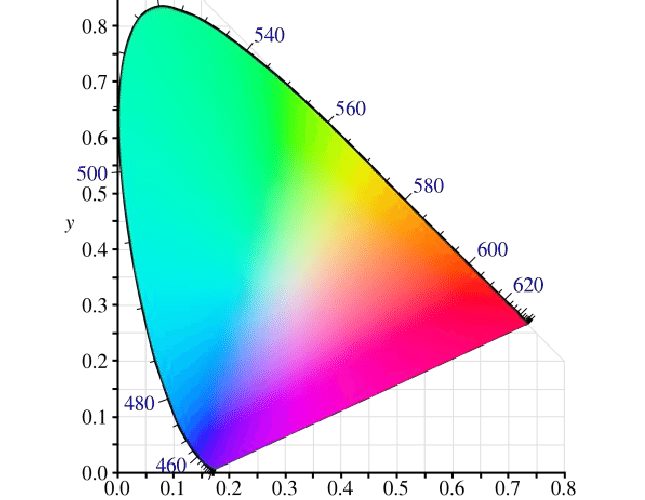
CIE RGB and CIE XYZ are foundational color systems developed to describe color mathematically based on human visual response.
CIE RGB
The CIE RGB system originated from color-matching experiments in which human observers recreated colors by combining red, green and blue primary light sources.
These experiments established mathematical relationships between light and human color perception and laid the foundation for modern color science.
CIE XYZ
CIE XYZ was later developed to overcome some limitations of RGB-based systems.
Its coordinates—X, Y and Z—are known as tristimulus values. Unlike RGB primaries, they are not intended to represent real physical light sources. Instead, they provide a universal mathematical framework for describing color.
Today, many color management systems and software solutions use variants or transformations of CIE XYZ because it offers a reliable basis for converting measured spectral data into numerical color coordinates.
For more on human color vision, see What Is Light? An Introduction to Human Color Vision and The Role of Rods and Cones in Color Perception.
What Is CIELAB?
CIELAB is a color space introduced by the CIE in 1976 to describe color in a way that more closely matches human visual perception.
It is based on a mathematical transformation of the CIE XYZ color space and was designed to be more perceptually uniform, meaning that distances between colors better correspond to how people perceive visual differences.
CIELAB uses three primary coordinates:
| Coordinate |
Represents |
| L* |
Lightness, from black (0) to white (100) |
| a* |
Green (-) to red (+) |
| b* |
Blue (-) to yellow (+) |
CIELAB can also be expressed using cylindrical coordinates:
- L* – Lightness
- C* – Chroma (color strength)
- h* – Hue angle
These values often make it easier to understand whether a color difference is primarily caused by lightness, hue or chroma.
What Is CIEDE2000?
CIEDE2000 is a color difference equation, not a color space.
It uses CIELAB coordinates but applies a more advanced mathematical calculation to better align numerical color differences with how people actually perceive color.
A standard CIELAB Delta E calculation measures the geometric distance between two points in CIELAB space. CIEDE2000 adjusts that calculation because human vision does not perceive differences in lightness, chroma and hue equally across every region of color space.
As a result, CIEDE2000 often provides color difference values that more closely match visual perception, making it a preferred option for many modern industrial color quality control workflows.
For a practical discussion of tolerance selection, see Best Practices for Delta E Tolerance Standards.
Why CIELAB Delta E and CIEDE2000 Delta E Are Not Compatible
CIELAB Delta E and CIEDE2000 Delta E should never be compared directly.
Although both calculations use CIELAB coordinates, they use different mathematical formulas to calculate the distance between two colors.
- CIELAB Delta E uses a straightforward Euclidean distance calculation.
- CIEDE2000 applies perceptual weighting factors for lightness, chroma and hue to better represent how humans see color differences.
Because of these differences, the same two samples can produce different Delta E values depending on the selected formula.
In many situations, CIEDE2000 values are numerically smaller than CIELAB Delta E values, but there is no universal conversion factor between the two.
This creates a significant quality control risk.
If a customer specifies a tolerance using CIEDE2000 while a supplier reports CIELAB Delta E, both parties may believe they are using the same metric when they are not.
For this reason, a specification should never simply state:
Delta E ≤ 1.0
Instead, it should clearly define:
- The Delta E formula (CIELAB, CIEDE2000, CMC, etc.)
- The illuminant
- The standard observer
- The instrument geometry
- The measurement mode
- Sample preparation requirements
- Visual evaluation conditions, where applicable
Related reading: 5 Steps for an Effective Color Quality Control Program.
Why Illuminant and Observer Settings Matter
Delta E values depend not only on the selected color difference formula, but also on the illuminant and standard observer used during calculation.
Illuminant
The illuminant represents the reference light source under which the color is evaluated, such as D65 daylight.
Standard Observer
The standard observer represents a mathematical model of human visual response, typically either the 2° or 10° observer.
If two measurements use different illuminants or different observer settings, their Delta E values may no longer be directly comparable—even when the same formula is used.
This matters because color appearance changes under different lighting conditions.
Two samples may appear identical under daylight but noticeably different under retail lighting, office lighting or LED illumination. This phenomenon is closely related to metamerism.
Learn more in What Is Metamerism?, Light Sources and Color Evaluation and Light Booths for Color Assessment.
What to Watch Out for When Comparing Spectrophotometer Specifications
When purchasing or comparing spectrophotometers, it is essential to verify that repeatability and inter-instrument agreement values are based on the same color difference formula.
Many instrument specification sheets list Delta E values for repeatability or inter-instrument agreement. However, if one manufacturer reports CIELAB Delta E while another reports CIEDE2000 Delta E, the numbers may not be comparable.
This can make one instrument appear more accurate than another, even though the comparison is technically invalid.
Before comparing specifications, always verify:
- The Delta E formula being used
- The illuminant
- The standard observer
- The instrument geometry
- The sample type used during testing
- Whether specular reflection is included or excluded
- How repeatability is defined
- How inter-instrument agreement is calculated
This level of scrutiny helps procurement teams, quality managers and laboratory professionals make informed purchasing decisions based on truly comparable performance data.
For more guidance, see What Are the Different Types of Color Measurement Instruments? and Why Should You Care About Inter-Instrument Agreement?.
Repeatability vs. Inter-Instrument Agreement
Although these terms are often mentioned together, they describe different aspects of instrument performance.
| Metric |
What It Measures |
Why It Matters |
| Repeatability |
How consistently one instrument measures the same sample repeatedly. |
Ensures stable measurements within a single laboratory. |
| Inter-Instrument Agreement |
How closely multiple instruments measure the same sample. |
Ensures suppliers, brands and production sites obtain comparable results. |
A company may have excellent repeatability within one laboratory while still experiencing disagreements between facilities if instruments are not properly aligned.
For global supply chains, both repeatability and inter-instrument agreement are essential for maintaining consistent color communication.
Additional guidance can be found in Best Conditions for Accurate Color Data and How to Store, Use and Clean Spectrophotometer Calibration Tiles.
Why Consistency Matters in Commercial Production
In commercial production, consistent color data supports faster approvals, fewer supplier disputes and more reliable quality control.
If brands, suppliers and production facilities use different color spaces, Delta E formulas, illuminants or observer settings, digital color communication quickly becomes unreliable.
Even when every team uses professional color measurement equipment, inconsistent settings can lead to different pass/fail decisions for the same sample.
This can result in:
- Rejected production samples
- Repeated lab dips
- Delayed product approvals
- Supplier disagreements
- Unnecessary rework
- Poor traceability and auditability
- Inconsistent product quality
- Incorrect instrument purchasing decisions
A standardized color workflow helps everyone evaluate materials using the same technical reference.
This is particularly important in color-critical industries such as:
- Textiles and apparel
- Plastics manufacturing
- Paints and coatings
- Packaging
- Paper production
- Automotive interiors
- Cosmetics and personal care
For industry-specific guidance, see Color Management in Textiles, Mastering Color Management in Plastics Manufacturing and Digital Color Management in the Paint and Coating Industry.
Best Practices for Using Color Spaces and Delta E Formulas
To avoid confusion and improve consistency, every color quality workflow should clearly define the color space, color difference formula and measurement conditions.
1. Use One Delta E Formula Throughout the Workflow
Select the formula that best fits your application and use it consistently throughout development, production and quality control.
Do not mix CIELAB Delta E and CIEDE2000 Delta E values within the same approval process.
2. Document Illuminant and Observer Settings
Always specify the illuminant and standard observer used during measurement and calculation.
This information is essential when comparing results between laboratories, suppliers or production facilities.
3. Standardize Instruments and Software Settings
Ensure that all instruments, software platforms and quality control systems use identical measurement settings.
Small configuration differences can lead to inconsistent pass/fail decisions.
4. Train Teams on Delta E Interpretation
Quality managers, laboratory technicians, procurement teams and suppliers should understand that a Delta E value only has meaning when the underlying calculation method is known.
Simply comparing numerical values without knowing the formula can lead to incorrect conclusions.
5. Combine Instrument Measurement with Visual Evaluation
Objective measurements should be supported by standardized visual evaluation whenever product appearance is critical.
This helps confirm that calculated color differences align with real-world visual acceptability.
6. Review Tolerances Using Production Data
If repeated approval disputes occur, review whether the selected Delta E formula, tolerances or measurement conditions remain appropriate for the material and application.
Adjusting the workflow based on production experience often improves consistency across the supply chain.
Checklist for Comparing Color Measurement Data
Before comparing color values or instrument specifications, verify that the following elements match:
- Color space
- Delta E formula
- Illuminant
- Standard observer
- Instrument geometry
- Measurement mode
- Sample preparation procedure
- Calibration status
- Environmental conditions
- Tolerance specification
If any of these differ, the resulting color values may no longer be directly comparable.
How Datacolor Supports Consistent Color Measurement
Datacolor helps manufacturers, brands and suppliers build reliable color quality workflows through objective measurement, standardized software and digital color communication.
Datacolor solutions help organizations:
- Measure color consistently across production sites
- Manage color standards and tolerances
- Improve supplier alignment
- Reduce approval disputes
- Support repeatable digital color communication
- Improve inter-instrument agreement throughout the supply chain
Relevant Datacolor solutions include:
Whether you’re comparing instruments or establishing global color standards, Datacolor can help you define the right measurement conditions, Delta E formula and workflow for your application.
Frequently Asked Questions About Color Spaces and Delta E
Can you compare results across different color spaces?
No. Color values and color differences should only be compared when they are based on the same color space, Delta E formula, illuminant, standard observer and measurement conditions.
Is CIEDE2000 a color space?
No. CIEDE2000 is a color difference equation. It uses CIELAB coordinates but calculates color differences differently from standard CIELAB Delta E.
What is CIELAB?
CIELAB is a color space that describes color using three coordinates: L* for lightness, a* for the green-to-red axis and b* for the blue-to-yellow axis. It is one of the most widely used color spaces in industrial color measurement and quality control.
What is Delta E?
Delta E is a numerical value that represents the difference between two colors. The meaning of the number depends on the formula used, such as CIELAB Delta E, CIEDE2000 or CMC.
Why are CIELAB Delta E and CIEDE2000 Delta E not comparable?
Although both calculations use CIELAB coordinates, they use different mathematical formulas. CIEDE2000 applies perceptual corrections for lightness, chroma and hue, which often produces different numerical values for the same pair of colors.
Which Delta E formula should I use?
The most appropriate formula depends on your industry, materials, customer specifications and quality workflow. Many modern production environments use CIEDE2000 because it often correlates more closely with human visual perception.
Why do illuminant and observer settings matter?
Illuminant and observer settings influence how color values and Delta E calculations are generated. Different settings can produce different results, even when measuring the same sample.
What should I verify when comparing spectrophotometer specifications?
Always confirm the Delta E formula, illuminant, standard observer, instrument geometry, repeatability, inter-instrument agreement and testing methodology before comparing instrument performance.
How can manufacturers avoid confusion during color quality control?
Document the complete measurement workflow, including the color space, Delta E formula, illuminant, observer, instrument settings, sample preparation and tolerance limits. Ensure suppliers and internal teams all use the same procedures.
Why is consistency so important in global supply chains?
Consistent measurement methods reduce supplier disputes, improve product approvals, minimize rework and ensure that every stakeholder evaluates color using the same objective standards.
Build More Reliable Color Measurement Workflows
Choosing the right color space, Delta E formula and measurement conditions is essential for consistent color quality. Datacolor helps manufacturers standardize color measurement, improve supplier alignment and make more confident quality decisions.
Connect with a Datacolor Color Expert

 Want to Get Color Right?