Paper brightness is a key quality-control metric that indicates how much blue light a paper sample reflects at 457 nm. In paper manufacturing, brightness helps teams evaluate pulp bleaching, optical brightener performance, batch consistency and the final visual quality of paper products.
Brightness is not the same as whiteness. Brightness focuses on blue reflectance at a specific wavelength, while whiteness evaluates reflected light across the visible spectrum. Both metrics matter, but they answer different quality questions. Brightness is often used to monitor process consistency and perceived cleanliness, while whiteness gives a broader view of the paper’s visual appearance. For a related explanation of how fluorescent and near-white materials behave during evaluation, see how to evaluate fluorescent white materials.
For paper mills, converters, print applications and packaging producers, accurate brightness measurement supports better production control, optimized material use, reduced waste and more consistent product quality. Teams that are building a broader measurement program can also benefit from understanding the different types of color measurement instruments used in quality control.
What Is Paper Brightness?
Paper brightness measures the reflectance of blue light from a paper surface, typically at a wavelength of 457 nm.
This wavelength is important because it is sensitive to yellowing in paper. Lignin, a natural component in wood-based pulp, can contribute to a yellowish appearance. A higher brightness value generally indicates that the paper reflects more blue light and appears brighter or less yellow.
In practical quality control, brightness helps manufacturers answer questions such as:
- Is the pulp bleaching process producing the expected result?
- Is brightness consistent from batch to batch?
- Are optical brighteners being applied effectively?
- Is the paper meeting customer or grade specifications?
- Will the paper support the intended print or packaging application?
Brightness is especially important in applications where visual cleanliness, print contrast, shade consistency or premium appearance affect customer perception.
Paper Brightness vs. Whiteness: What Is the Difference?
Paper brightness and paper whiteness are related, but they are not interchangeable.
Brightness measures reflectance at a specific blue wavelength, usually 457 nm. It gives a focused indication of how bright or less yellow a paper appears in the blue region of the spectrum.
Whiteness measures the balance of reflected light across the visible spectrum, approximately 380 nm to 720 nm. It provides a broader assessment of how white the material appears under defined lighting conditions.
The CIE Whiteness index is commonly used to describe the relative whiteness of near-white materials. It produces a single-number value that helps compare samples under specified conditions.
A paper can have high brightness but still differ in whiteness if the overall spectral balance is not the same. That is why quality teams often monitor both brightness and whiteness, depending on the product grade, customer requirement and end-use application. For teams that need a broader foundation in color spaces and color difference metrics, Datacolor’s guide to CIELAB and CIE2000 color systems provides useful context.

Why Brightness Control Matters in Paper Production
Brightness control affects both product appearance and production performance.
For customers, brighter paper is often associated with cleanliness, print sharpness and higher quality. In printing, paper brightness can influence contrast, color vibrancy and the perceived clarity of printed images or text. In packaging and specialty paper, brightness and whiteness can affect brand presentation and shade consistency across production lots.
For manufacturers, brightness control is equally important inside the process. Reliable measurement helps teams detect variation early, correct process drift and reduce off-spec production.
Effective brightness management can support:
- More consistent paper grades
- Fewer rejected batches
- Better print and converting performance
- Optimized use of bleaching agents and optical brighteners
- Reduced waste from overcorrection or late-stage quality failures
- Stronger documentation for customer specifications and audits
Brightness is therefore not only an appearance metric. It is a process-control metric tied to efficiency, cost and customer acceptance. For a broader framework on building a structured quality workflow, see 5 steps for an effective color quality control program.
How Paper Brightness Is Measured
Paper brightness is measured using standardized test methods that define the light source, measurement geometry, wavelength and sample conditions.
Common standards include:
- TAPPI T452, often associated with directional brightness measurement
- TAPPI T525, used for diffuse brightness measurement
- ISO 2470, used for ISO brightness
- ISO 2469, which defines measurement conditions for diffuse reflectance factors
These methods help ensure that brightness values are comparable within a defined standard. However, results from different methods are not always directly interchangeable. Paper texture, surface structure, fluorescence, opacity and measurement geometry can all influence results.
Spectrophotometers are used to measure these properties with greater precision and repeatability. In paper quality control, a dedicated instrument helps teams standardize measurement conditions and reduce operator-dependent variation. For more general guidance on instrument-based measurement, read using a spectrophotometer for color measurement.
Diffuse vs. Directional Brightness Measurement
Diffuse and directional brightness methods illuminate the paper differently, which can lead to different results.
Diffuse Brightness Measurement
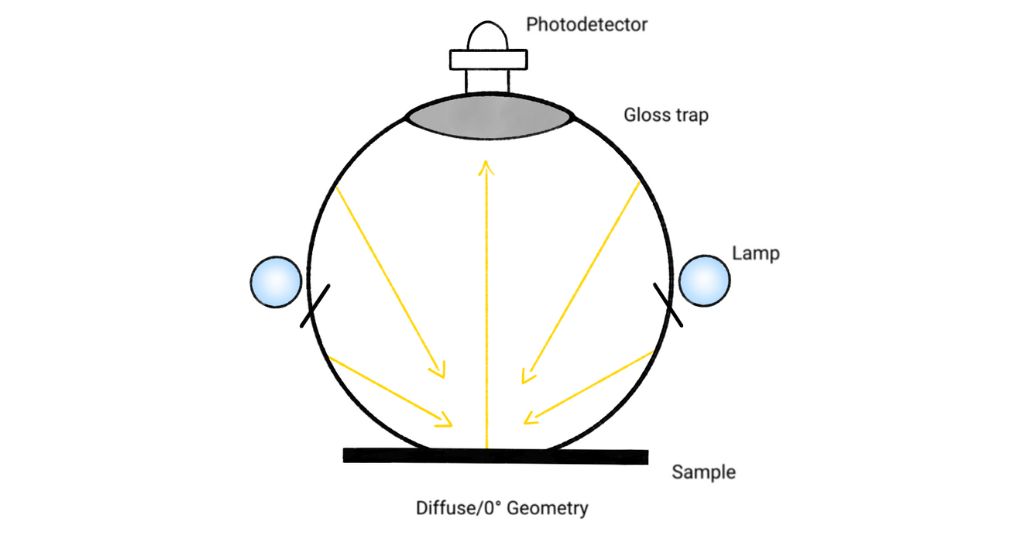
Diffuse brightness measurement scatters light uniformly across the sample surface. This method typically uses an integrating sphere to distribute light evenly and measure reflectance under controlled geometry.
Diffuse illumination, such as d/0° geometry, is widely accepted in the paper industry because it reduces the influence of surface directionality and provides a more general measurement of the paper’s reflectance.
Directional Brightness Measurement
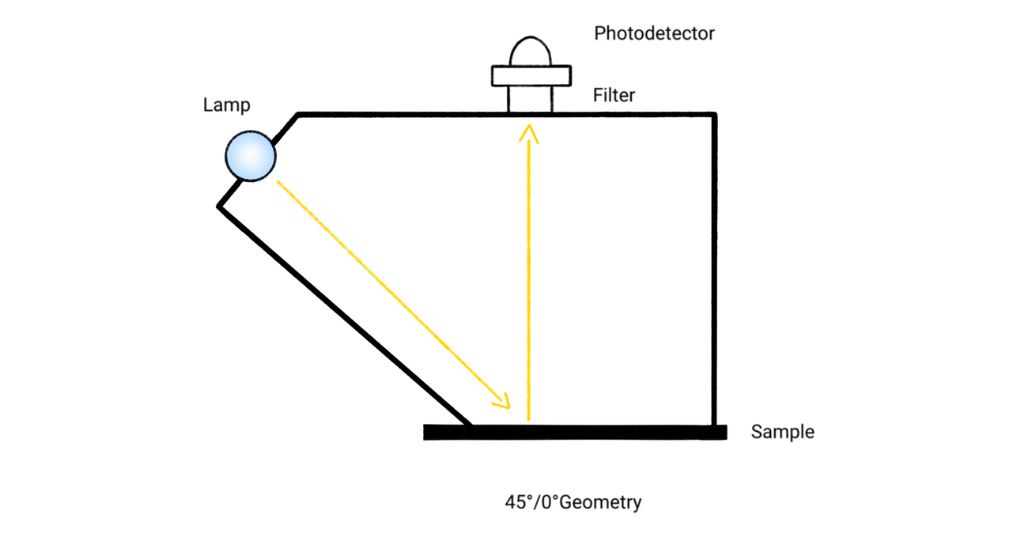
Directional brightness measurement uses a light source at a defined angle, commonly 45°/0°. This method measures how light reflects from the paper in a specific direction.
Directional methods can be useful in certain contexts, but they may be more affected by surface texture, formation, fiber orientation, gloss or sample structure. If the paper has visible structure or surface variation, directional measurement can produce different results than diffuse measurement. Similar appearance-related variables are important in other color-critical materials as well; Datacolor explains one common factor in how gloss impacts color measurements and matching.
The key point for quality control is consistency. Teams should use the measurement method required by the relevant standard, customer specification or internal quality program—and document it clearly.
How Optical Brighteners Affect Paper Brightness
Optical brighteners are additives used to increase the perceived brightness and whiteness of paper.
They work by absorbing ultraviolet light and re-emitting it as visible blue light. This added blue emission can make paper appear brighter and reduce yellowish appearance. However, the measured effect depends on the UV content of the light source, the type and amount of brightener, the paper substrate and the measurement conditions.
Optical brighteners need to be controlled carefully. Too little may fail to meet the target brightness or whiteness. Too much may increase cost, create instability or produce results that vary under different lighting conditions.
Accurate measurement helps manufacturers optimize optical brightener use. This supports both product quality and material efficiency, especially in grades where brightness specifications are tight or customer expectations are high. Because optical brighteners respond to ultraviolet light, measurement teams should also understand light sources in color evaluation and how viewing conditions can influence perceived color.
Best Practices for Paper Brightness Quality Control
A strong brightness control program depends on standardized methods, stable measurement conditions and consistent sample handling.
1. Define the Required Standard
Specify whether the product is measured according to ISO, TAPPI, DIN, SCAN or another relevant method. Brightness values should always be interpreted in relation to the method used.
2. Use the Right Measurement Geometry
Choose diffuse or directional measurement based on the applicable standard and customer requirement. Do not compare results from different geometries without understanding the method difference.
3. Control UV Conditions
Because optical brighteners respond to ultraviolet light, UV content can affect brightness and whiteness results. Measurement conditions should be defined and repeatable.
4. Prepare Samples Consistently
Sample conditioning, surface selection, stacking, opacity, orientation and cleanliness can influence results. Quality teams should use documented procedures to reduce variation. For practical guidance on reducing measurement variation, see sample measurement technique for digital color communication and sample conditioning for digital color measurement.
5. Monitor Both Brightness and Whiteness When Needed
Brightness alone does not fully describe paper appearance. For many grades, whiteness, shade, opacity and color coordinates may also be needed to understand visual quality.
6. Track Process Trends, Not Only Final Results
Routine measurement allows teams to detect drift earlier in bleaching, brightener dosing, furnish changes or production conditions. Early detection helps reduce waste and avoid late-stage rejection.
7. Maintain Instrument Performance
Calibration, cleaning, service and instrument agreement are essential for reliable measurement. In multi-site or supplier workflows, instrument alignment is critical for consistent quality decisions. Datacolor covers this topic in why inter-instrument agreement matters and how to store, use and clean spectrophotometer calibration tiles.
How Datacolor Elrepho 1000 Supports Paper Measurement
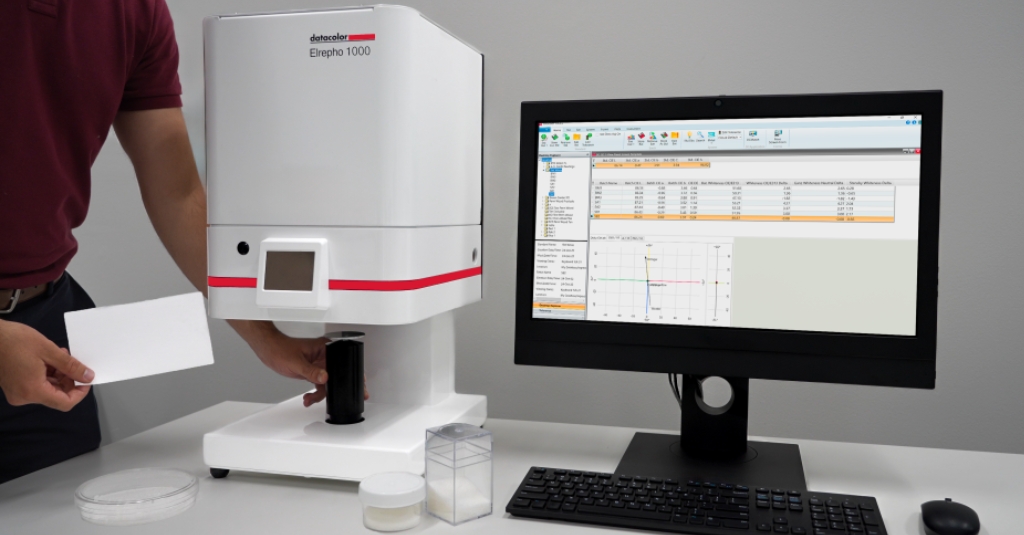
The Datacolor Elrepho 1000 is designed for precise color and optical property measurement in the paper industry.
It supports a wide range of industry standards, including ISO, DIN, SCAN and TAPPI methods, helping paper manufacturers measure brightness, whiteness, opacity and related properties with confidence. Learn more about the Datacolor Elrepho paper measurement solution.
For quality control teams, this matters because paper measurement is highly method-dependent. A reliable spectrophotometer helps reduce variation, support auditability and provide the data needed to make process decisions faster.
Using a dedicated paper measurement solution can help teams:
- Monitor brightness and whiteness consistency
- Optimize optical brightener use
- Reduce off-spec production
- Support customer specification compliance
- Compare production lots more reliably
- Document results for internal and external quality requirements
For paper manufacturers looking to improve consistency and process control, accurate brightness measurement is a practical step toward better quality and fewer avoidable production issues. Teams looking to connect paper measurement with broader workflow control can also explore color management solutions and Datacolor Tools quality control software.
FAQ: Paper Brightness and Whiteness
What is paper brightness?
Paper brightness measures how much blue light a paper sample reflects, typically at 457 nm. It is used to evaluate brightness, yellowing and consistency in paper production.
What is the difference between brightness and whiteness?
Brightness measures reflectance at a specific blue wavelength. Whiteness evaluates reflected light across the visible spectrum and gives a broader indication of how white the paper appears.
Why is brightness measured at 457 nm?
The 457 nm wavelength is sensitive to blue reflectance and helps indicate the degree of yellowing or bleaching in paper.
Why do optical brighteners affect brightness?
Optical brighteners absorb ultraviolet light and re-emit it as visible blue light. This can increase the perceived brightness and whiteness of paper.
Why can different brightness methods give different results?
Different standards use different measurement geometries, light conditions and procedures. Paper texture, fluorescence, opacity and surface structure can also affect the result.
What is diffuse brightness measurement?
Diffuse brightness measurement uses scattered, uniform illumination to measure reflectance. It is commonly used in the paper industry because it reduces the influence of surface directionality.
What is directional brightness measurement?
Directional brightness measurement uses a light source at a defined angle, such as 45°/0°. It can be more affected by paper texture, surface structure or gloss.
Why is brightness important for printing?
Brighter paper can improve perceived contrast, clarity and color vibrancy in printed materials. It can also influence how customers judge print and paper quality.
How can paper mills improve brightness control?
Paper mills can improve brightness control by using standardized measurement methods, controlling optical brightener dosing, monitoring process trends and using reliable spectrophotometers for quality control.
Want to learn more about the Elrepho 1000?
Chat with an Expert!


 Want to Get Color Right?